Tuesday, June 11, 2013

Week Eight, Assignment Four: Two nonfiction booktalks

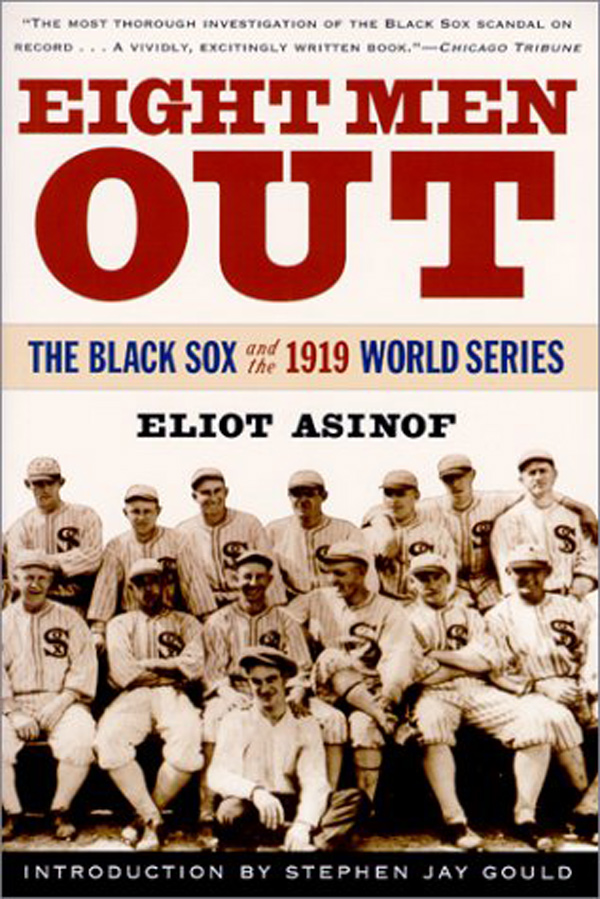
Eight Men Out, Eliot Asinof, 1963.  That the 1919 World Series was thrown by the Chicago White Sox was not unique -- sports was rift with betting and criminal influence, both before and since.  What made the "Black Sox Scandal" so noteworthy is the way the baseball club owners instituted a higher authority -- the National Baseball Commission -- and handled the problem from the inside out, and from the top down.  Eight Chicago players were initially placed on a makeshift "ineligible" list (with the promise to be reinstated if found not guilty of their accusations), and eventually indicted on various conspiracy charges.  All eight were acquitted.  All eight were never allowed to play professional baseball again. 
Appeal factors such as characterization, setting and detail are all pronounced in Asinof's book.  The team roster comes to life and the motivations for the players to do what they were accused of doing (remember, they were acquitted so you can't legally say they did anything illegal!) are clear: they played baseball for a man (Charles Comiskey) who was so notoriously cheap that one story behind the name "The Black Sox" predates the gambling scandal and instead refers to Comiskey's making his underpaid players pay for their own uniform laundering -- and in protest, they played until the white-with-black-pinstripe uniforms were almost completely black with grime. 
 
The best baseball club in the world worked for fame and fortune for a man who wouldn't share the fortune he was making off of them.  Wouldn't that gambler's money be pretty durn tempting to men who'd been cheated out of promised bonuses and benefits? 
 
Asinof, writing 40 years after the facts, and while some of the principals were still living (four of The Eight were still alive when the book was published), relied almost entirely on newspaper accounts and other researches -- his introduction says that he met with some of the 1919 team but no one would talk to him about the World Series.  Why not?  What would so stigmatize the players that they felt they couldn't speak to a reporter about the event that forever changed their lives?
 
 
Misquoting Jesus: The story behind who changed the Bible and why, by Bart D. Ehrman, 2005.  Ehrman is one of the most read biblical scholars around these days.  He wrote a slew of best-selling (well ... in this context "best-selling" is very relative) books on the origins of the New Testament and, as in this work, how the teachings of Jesus of Nazareth have been misconstrued or completely manufactured in the 1600 years since the form of the New Testament was codified. 

This topic, and the history of Christianity, has long fascinated me, probably contributing to my heretical bend.  Ehrman started his career as an Evangelical Christian, out to prove that the Bible was actually and literally written by "God" and therefore inviolate by us mere humans, but his open-eyed researches have lead him to other conclusions.  I think this is what I like so much about his work: it's the former smoker who makes the most convincing anti-smoking crusader, after all.  Plus his research seems (to a non-specialist) fair, balanced, and thorough.

This is not to say Ehrman is anti-Christian, at all.  He's just become much more scholarly than he originally intended, and has some interesting and, to some, controversial conclusions about the earliest versions of Christianity -- which he calls proto-orthodox Christianity.

This book would be a natural to recommend to those who are intrigued by the religious aspects of Dan Brown's Robert Langdon series -- but unlike Brown, Ehrman's books, shorter on story-line, are much longer on research and detail.  (In fact, Ehrman wrote one of the [many] books that debunked some of Brown's conspiracy theories, namely Truth and Fiction in The Da Vinci Code, 2006.)

Also recommended (maybe even more strongly but we no longer have it in the BCPL collection) is Ehrman's 1999 Jesus: Apocalyptic Prophet of the New Millennium.


Week Eight, Assignment Three: Four nonfiction recommendations

"Choose any four of the 16 nonfiction genres ... list Dewey call numbers for those genres ....  Choose and recommend a book for someone who normally doesn't read nonfiction."

In a surprise move, Bryce chooses the genres of Sports (790s, generally), Faith (200s) ... and then resorts to the old faithfuls of History (900s) and Biography/Memoirs (which SLRC's video divides into two separate genres -- I disagree.  They live, in BCPL at least, in B or, in Dewey terms, the 920s, with some in other sections throughout the collection, depending on a myriad of reasons best understood by cataloguers -- as an example, if 51% of a biography is about the subjects fight against heroin addiction, you might find it in the "substance abuse" section, in the 616s).

In Sports -- and people who know me know I'm not a fan at all, really, but I do have an historical appreciation for Sports and can fake it when some jock wants to talk about how The Ravens, Orioles, Blackhawks, Lakers, or Pomona College Sagehens did last night -- I'd recommend Eliot Asinof's book on the Chicago "Black Sox" Scandal of 1919, Eight Men Out (796.357 A).  A detailed "book talk" will follow. 

In Faith -- and people who know me know I'm not a fan at all, really, but I do have an historical appreciation for Faith and can fake it when someone want to talk about the Torah, the Bible, the Lotus Sutra, or the Book of Mormon -- I'd recommend Bart D. Ehrman's Misquoting Jesus (225 E). 

History is my "thing," I enjoy it a lot, and despite its somewhat dry reputation, there has been a lot of good narrative nonfiction in the discipline ever since Tacitus' time.  Fiction readers might be intrigued by Simon Winchester's A Crack in the Edge of the World, about the San Francisco earthquake and fire of 1906 (979.461 W), among literally thousands of others.

Memoirs and biographies are just "personal" histories, so semi-obviously a history nerd is going to enjoy them, too.  Truman, by David McCullough, tells in vibrant terms the story of "Give 'Em Hell Harry," the President perhaps best known for nuking Japan and firing General MacArthur for insubordination (Biography [or 920] TRUMAN).   


Monday, June 10, 2013

Week Eight, Assignment Two: View a SRLC video.

Done.  Good job, State Library Resources Center!  I sort of disagree that Biography and Memoir are two separate genres, though -- more like two sides of the same coin, one written in the third person, and presumably without an "agenda," the other usually in the first person, and generally with an "agenda" (those that say the loudest that they HAVE no agenda are those with the most profound ones). 

Week Eight: Nonfiction

Or, as Cole Porter and Peter Bogdanovich might say, "At Long Last, Love." 

I'm a big-time reader of non-fiction.  Not that there's anything wrong with fiction,  I enjoy it, too, but I read far more non-fiction, always have, always will. 

For the first part of this assignment, we read articles by Jennifer Brannen, "Borderlands: Crossing between Fiction and Nonfiction in Readers' Advisory," and Catherine Sheldrick Ross, "Reading Nonfiction for Pleasure: What Motivates Readers?"  Brannen's was a good opinion piece, based on experience and principle, but I found more value to Ross's article, if only because hers is based on interviews and her own personal research.  (To be fair, the articles are two different approaches to the same general subject -- one is opinion-based, and the other research-based). 

The assignment doesn't specify that we're to respond on our blog to the articles, but I wanted to.  One of the quotes in Ross's article reminded me of a dialogue in the 2004 film, Sideways.  The writer, played by Paul Giametti, has been asked by his best friend's father-in-law-to-be about his book:

Miles (Giametti): It's... it's a novel. Fiction. Yes. Although there is quite a bit from my own life... so I suppose that, technically some of it is nonfiction.
Mike (played by Shaun Duke): Good, I like nonfiction. There is so much to know about this world. I think you read something somebody just invented, waste of time.
Miles: That's an interesting perspective.


Week Seven, Assignment Four: Trends in YA (at least according to the publishers)

"Choose any two ... spend some time ... blog about trends."

I chose Harlequin Teens and Teens at Random, the former because I think Harlequin really is the Little Publisher That Almost Could, If Only They Paid Better, and the latter because the title is amusing. 

Harlequin Teens seems to have its exploitative finger on the pulse of what adults who read the trade papers think teens will buy, with an overlay of the patented Harlequin romance.  There's teen cyberpunk romance, teen steampunk romance, teen horror romance -- you name it, throw in a romantic subplot, and Harlequin will sell it to you!  Good job of following the trends rather than establishing them, Harlequin!  Can't really fault them for this, though -- it's a business plan that works.  Just ask Hollywood.

Teens at Random looks pretty much like Random House's other themed pages, but with lighter, more teen-friendly typefaces.  As one of the biggest publishers around, Random House doesn't seem to rest on their laurels but offers newer more innovative works than a second-tier publisher like Harlequin can.  A well-done and inviting site, with book-trailers and everything -- as you'd expect from Random House. 

Trendspotting?  Harlequin is sure the kids will want what they've been buying, and Random is pushing Tess Gratton (The Lost Sun: two holds at this writing) and Tom McNeal's Far, Far Away, which has four holds. 


Week Seven, Assignment Three: Comment on a pair o' Blogs

"Choose any two of the following blogs/websites.  Follow them for a week and post comments."

I chose John Green's fansite/blog/vlog Books, and his Tumblr, and Shannon Hale's Squeetus Blog

John Green, author of the hyper-popular The Fault of Our Stars, has a very entertaining vlog/blog in Books, with loads of updates on his fresh-born daughter Alice, born June 3.  This is apparently put together by one Hank, who looks like the famous cowdog of the same moniker.  (Hank actually looks more like Stephen Merchant but with a name like "Hank," you gotta throw in a cowdog reference.)  There's some good content here, even some interviews with Green. 

Hank the Cowdog

Stephen Merchant, friend of Ricky Gervais and Karl Pilkington
Of course anything remotely "official" to the current most-popular YA author will be successful -- that's kind of the nature of the beast -- but both these sites are, I think -- the second slightly less so, but that's probably a generational thing: I think Tumblr is silly. 

Shannon Hale's blog is very entertaining.  I especially enjoyed her self-deprecating responses to the successful author's never-ending question, "will there be a sequel to Princess Academy?"  She facetiously responds that, beyond the "real" sequel, Palace of Stone, a whole cottage industry will be springing up, her "new" sequels illustrated with cover art for the first slew, which will include Vampires in Love, Laser Eyes, and Revenge of the Mountain Goat.  I suppose these would be even funnier if I'd read Princess Academy.


Thursday, June 6, 2013

Week Seven: Not Just For Teens

Assignment One: Review a flowchart

Consider it reviewed.  A little snarky, a little sarcastic, and librarians like that.  Humorous, with good info: librarians like that, too!

Assignment Two: Read a couple of articles, comment on my blog, review and comment on two others' blogs about their comments on these articles. 

I read "'New Adult': Needless Marketing-speak or Valued Subgenre?", from Publisher's Weekly, Dec 14, 2012.  In answer to the title, I think "New Adult" is both.  It defines a particular subgenre of Young Adult fiction -- that which depicts, models or contemplates the notion of "becoming an adult" -- whereas most YA fiction seems more concerned (at least according to the other article I read) with vampires, zombies, and dystopias.

Of course this is unfair to YA fiction: I enjoy it quite a lot and there's far more to it than just the "dark" themes the second article alludes to.  That article is "YA Comes of Age," also from Publisher's Weekly, dated October 3, 2011.  The article is a bit dated, having come out after the huge popularity of Twilight and just as The Hunger Games and its dystopian brethren were ruling the sales charts.  YA is still in "dark and dystopian" mode, due to these and other influences, and probably will be for some time -- the kids just seem to love that stuff, it's a product of the Age we live in (and meshes nicely with the Goth, emo and other subcultures that parents wish would just go away ...).

YA is a broad and deep genre, more than just these facets, but these are still the seemingly most popular ones.  I think it will be quite a while before we see anything analogous to Nancy Drew, the Hardy Boys, Rebecca of Sunnybrook Farm and the Little House books (which were the YA lit of their generation, before YA existed).

I left comments on Doug B and Rebecca B's blogs.

Assignments Three and Four will take a little more time.